
Introduction: clean air, safe environment
In sectors such as pig farming, animal husbandry and the food industry, one thing is vital: hygiene. Not as a fashion trend, but as a daily necessity. Preventing germs, protecting food safety and improving the barn climate are all crucial factors in these environments.
Nebulization systems play an increasingly important role in this. They are used to disperse disinfectants, disinfectants or odorants – quickly, evenly and safely. And at the base of many of these systems is a silent force: the side channel blower.
In this blog, we dive into the world of atomization and air pressure. We show how side channel blowers are used in demanding industrial applications, and why their performance is so important for clean and reliable operations.
What does a nebulizer do?
An industrial misting system converts liquid into fine droplets, which are then dispersed through an area using air. Think barns, food processing areas or cleaning areas.
The goals are varied:
- Disinfection of surfaces or environments
- Neutralization of odors
- Prevention of dust formation
- Climate Control
Typical liquids:
- Water (with or without additives)
- Disinfectants (such as hydrogen peroxide, chlorine solutions)
- Essential oils or fragrance binders
- Cleaning agents
For effective operation, consistent airflow is essential – and that’s where the side channel fan comes in.
Why side channel fans?
Side channel fans are ideally suited for applications where constant, reliable airflow is required, without pulsation or pressure fluctuations. Unlike compressors, they deliver medium pressure with high air output, continuously and quietly.
This makes them ideal for misting systems.
Key features:
- Oil-free and low maintenance
No risk of air or fluid contamination. - Low Noise
Ideal for barns and food processing, where noise pollution is undesirable. - Suitable for continuous operation
Can easily run 24/7 without overloading. - Compact design
Easy to build into mobile or fixed installations.
A well-chosen side channel fan delivers exactly the air output needed to atomize liquid into a fine mist, without wet spots or overdosing.
Applications in practice
Pig farm
In modern pig houses, misting systems are used for both disinfection and climate control. For piglet departments, for example, where young animals are especially susceptible to infection, a nebulization system ensures a dry, hygienic environment. Rapid disinfection is also essential when animals are transferred between departments.
In doing so, the blower creates an even airflow that disperses the mist throughout the room – with no drafts and no noise.
Livestock and dairy farms
Hygiene in milking rooms and waiting areas is crucial for preventing udder infections and cross-contamination. Here, misting systems are used with hydrogen peroxide, for example, to quickly clean surfaces and equipment between milkings.
The blower quickly disperses the atomized liquid, so employees do not lose valuable time and dairy cows can remain in a clean environment.
Food Industry
In food processing – from meat to dairy to vegetables – the strictest hygiene requirements apply. Nebulization systems are used for this:
- Cleaning of machines and workbenches
- Disinfection of floors and walls
- Air freshening and odor control
Here, a blower must not only be reliable, but also meet strict food safety requirements. Oil-free operation and low noise production are absolute musts.
Why air yield and stability are so important
Atomization is all about the right balance of air and liquid. Too little air? Then droplets, not fog, are created. Too much pressure? Then the fog dissipates or the system becomes overloaded.
A side channel blower is so valuable because it delivers stable air output over a long period of time, without pulsing. This ensures:
- Even spray
- Efficient fluid use
- Higher effectiveness of disinfection
- Reduced risk of wet surfaces or condensation
So choosing the right blower means proper performance, less waste and better hygiene.
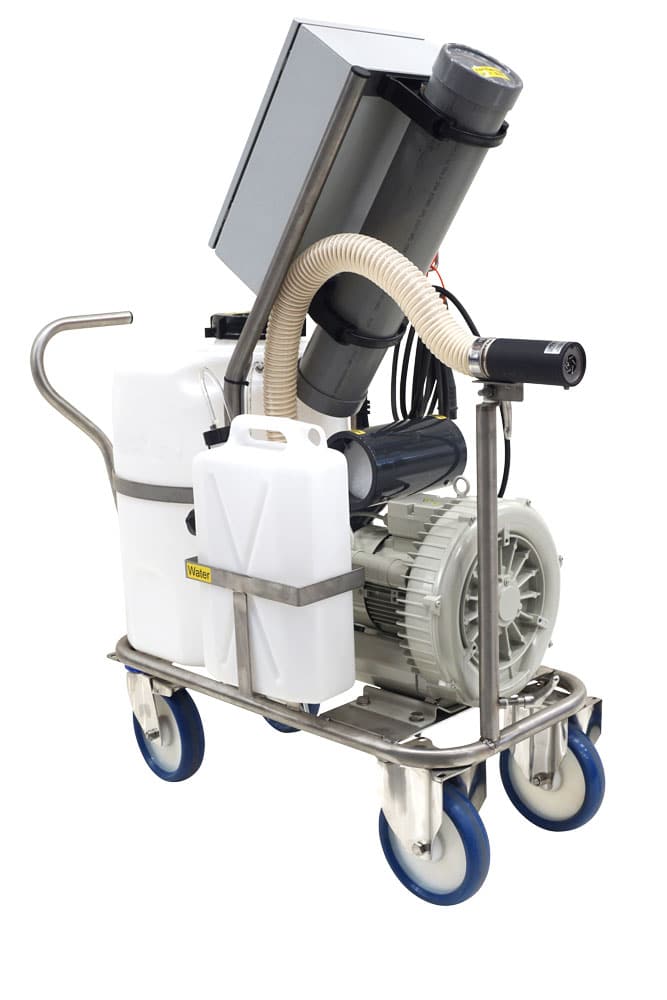
In practice: the Powerfog V60
A great example of such a professional application is the Powerfog V60: a powerful nebulizer widely used in the livestock and food industries, among others.
This machine is developed and supplied by Veugen Technology. DOVAC is not the supplier of the Powerfog itself, but of the side channel fan used in the system.
In this system, the blower draws in and atomizes liquid, dispersing it as a fine mist through a rotating nozzle. The result is a quiet, efficient and powerful atomization that treats large areas quickly and evenly.
In doing so, the blower is not simply “added on,” but is tailored to:
- Nozzle pressure
- Liquid viscosity
- Application time
- Required drop size
At DOVAC, we actively consider the right blower, the desired air output and the technical integration into the system in these types of projects.
What is important when choosing a blower for atomization?
If you work with nebulization systems, the blower is more than an accessory. It is the heart of your system. Therefore, pay attention:
- Air output at desired pressure range
- Oil-free operation for hygiene-sensitive applications
- Noise level (especially in animal and people-rich environments)
- Continuous load capacity (in long-term applications)
- Installation options and size
At DOVAC, we supply side channel fans in a variety of capacities – from compact mobile to large industrial – and help you make the right choice for your application.
Conclusion: silent force behind clean systems
Side channel blowers play an invisible but crucial role in many industrial hygiene systems. Whether in swine barns, dairy farms or food processing – the quality of the airflow determines the effectiveness of atomization.
A well-chosen and correctly integrated blower provides:
- Efficient use of disinfectants
- Even distribution of mist
- Less noise and maintenance
- More safety and hygiene
Want to make sure your nebulization system works the way it should – efficiently, safely and low-maintenance?
Then we will be happy to help you find the right blower, tailored to your application. Because well-chosen air solutions make the difference between just another installation and a system that really performs.


